



The ISAF Racing Rules of Sailing are revised and published every four years by the International Sailing Federation, the world governing body for the sport.
The current edition, The Racing Rules of Sailing 2013-2016, came into effect on 1 January 2013.
The Racing Rules of Sailing includes two main sections. The first, Parts 1-7, contains rules that affect all competitors. The second section contains appendices that provide details of rules, rules that apply to particular kinds of racing, and rules that affect only a small number of competitors or officials.
There are many Mirror sailing events all around the world, from club regattas to national, regional championships to continental and onto World Championships.
Visit your national class association website for details of events within your country. The Mirror sailing Event Calendar contains more comprehensive information on the major Mirror events around the world.
If you are going to your first major regatta, make sure you have all the relevant documentation that you will be required to present to the Organizing Committee, at registration and measurement, such as:
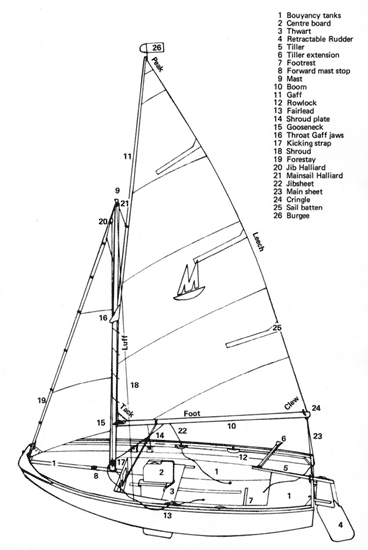 For those with older boats here is the original rigging guide. We plan to add other options later.
The Mirror was designed to introduce the masses to sailing, with the chance to own your own boat cheaply. Many tens of thousands fulfilled their dreams by building a Mirror from a kit. Building a Mirror is not difficult, easy accomplished by anyone with basic DIY skills. These days many prefer the convenience and low maintenance of a GRP/foam sandwich Mirror.
The Mirror dinghy is an International Class, so it's class rules and licenced builders/kit manufacturers are administered by World Sailing. Mirrors can only be built from a kit supplied by a World Sailing Licenced Kit Manufacturer. Please see the World Sailing Mirror Class Page for the current list of kit manufacturers under the "Suppliers" tab.
Where a builder does not have a website, more details may be available on the countries Mirror Class Association website. There is also more information on building a kit, plus copies of the Building Instructions on the UK Mirror Class Association website.
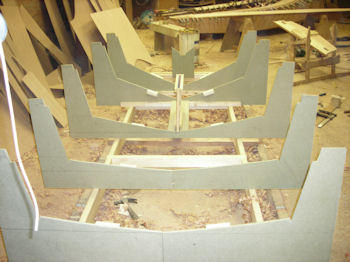
The vast majority of wooden Mirrors were built using the original 'stitch and glue' method. In the 1990 some racing Mirrors were built on jigs that greatly help to achieve a good and fast shape. If you are interested in building a kit on a jig, here is Phil Rust's story of building GBR 70362 (using the Goodwin jig).
All content belongs to, and copyright © of, the the International Mirror Class Association. Design and Maintenance - The WebGuru, Martin Egan